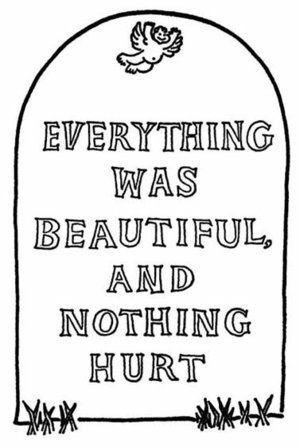
Everything was Beautiful and Nothing Hurt
The star of Kurt Vonnegut’s Slaughterhouse Five, Billy Pilgrim, thinks the above thoughts when his daughter asks him questions about what it was like to be in the war. The whole book is about the craziness and cruelty of war, and Billy Pilgrim is obviously being ironic. He even thinks about putting that motto on his tombstone. I’ve been thinking about that quote today because I sometimes think that people want to hear such words when you’ve been through cancer. The past few weeks, I’ve also been reading Barbara Ehrenreich , a cell biologist, whom I greatly admire. I often taught her essays to freshmen at UT and thought she was an insightful, talented writer. Recently a male friend gave me two of Ehrenreich's books—unbeknownst to him that I admired her, and, most importantly, that Ehrenreich has had breast cancer.
The two books are Living With a Wild God about an epiphany that Ehrenreich had as a teen that changed her thinking about the universe, and her new book Natural Causes which argues that we, as modern people, are too obsessed with NOT dying and staying young. She’s 77 herself and going strong.
Somewhere along the way in my reading, I discovered she was diagnosed with breast cancer in 2000, and she really tired of people saying things like “Cancer is a gift.” If you want to read what she wrote in the Guardian read: “Smile You Have Cancer”:
https://www.theguardian.com/lifeandstyle/2010/jan/02/cancer-positive-thinking-barbara-ehrenreich
(This link sometimes doesn't work, but you can cut and paste it or type in Ehrenreich and Smile You Have Cancer and The Guardian and the link should come up.)
This essay talks about the dangers of being too optimistic about cancer. A longer piece about her cancer appeared in Harpers magazine in 2001, and she reprinted it on line. Here’s the link: http://barbaraehrenreich.com/cancerland/. My favorite lines from this piece are the following: “This is the one great truth that I bring out of the breast-cancer experience, which did not, I can now report, make me prettier or stronger, more feminine or spiritual — only more deeply angry. What sustained me through the ‘treatments’ is a purifying rage, a resolve, framed in the sleepless nights of chemotherapy, to see the last polluter, along with, say, the last smug health insurance operative, strangled with the last pink ribbon.”
I LOVE cancer "did not make me make me prettier or stronger, more feminine or spiritual."
Now, don’t get me wrong. I like some of the pink ribbon stuff and enjoy my friendships with those who have also had cancer and those who have loved/cared for me during my treatment, but I find Ehrenreich’s perspective refreshing.
One more quote from literature since I’m on a literary kick today. One of my favorite short stories is “Sonny’s Blues” by James Baldwin. It’s about a self-righteous older brother, who is also a math teacher. The brother is trying to help his younger, musician brother get off heroin. Two important messages to me from this story. First, the older brother says to his brother who is despondent: “I wanted to talk about will power, and how life could be well, beautiful.” I believe that--that life can be beautiful despite cancer.
At some point, (paraphrasing) Sonny tells his older brother, "Everyone suffers--they just express it in different ways."
Second, here are the lines I love, love, love. They're about a) finding either someone to listen to you when you’re down and suffering or b) finding a way to express your suffering in art:
"It's terrible sometimes, inside," he said, "that's what's the trouble. You walk these streets, black and funky and cold, and there's not really a living ass to talk to, and there's nothing shaking, and there's no way of getting it out- that storm inside. You can't talk it and you can't make love with it, and when you finally try to get with it and play it, you realize nobody's listening. So you've got to listen. You got to find a way to listen."
We've all got to find a way to listen to our suffering. And who says you can’t learn something from TV shows like “The Closer” on Italian TV (I was in Siena last week). In one episode that I watched, a kid dies unnecessarily and the Chief (I forget her name) asks a priest, “Was there a reason for this?” And the priest says, “That question is too hard for me. I do think it is up to us to make meaning of his death.” That’s what I believe. What I do to find meaning is to write through this blog and poetry. And we have to all tell our own stories. As Baldwin writes: "For, while the tale of how we suffer, and how we are delighted, and how we may triumph is never new, it always must be heard. There isn't any other tale to tell, it's the only light we've got in all this darkness."
More later (from me) about what doesn’t kill you, can make you (wait for it)…WEAKER. It’s about sneaky side effects of treatment and cancer.