Farewell Captain Janeway and a Poem About Being a "Star"
Here I am creeping back to the computer after being away from my blog for 9 or more months. Honestly, I’ve just been tired—mentally and physically. I finished chemo the end of last July and spent most of my time in August willing my hair to grow. I don’t remember much about August—a few hikes, meeting with surgeons (plastics and oncology) to determine my treatment. My surgeon at first thought I should have a mastectomy of my left breast because my cancer is arguably one of the most aggressive of the types (triple negative) and my tumor was Stage 3, grade 3C—you can have stages up to 4 and grades 1, 2, 3 and then they are further divided to a,b,c. Everyone thinks theirs is the most aggressive (understandably) but the stages, type, and grades of tumors tell the facts. The only good thing on my side was the cancer wasn’t at stage 4 (which means it hadn’t spread to other organs other than lymph nodes). Dan and I both argued that the cancer could come back on chest wall so why take the whole thing if it wouldn’t guarantee a better success rate? We won in the end; the surgeon was probably convinced because my ultrasound showed “No Evidence of Disease” after chemo although that was a bit misleading as I mention later. You never say “My cancer was cured” although I've mistakenly said it. You can say "there was no evidence of disease (NED)" because you never know! It’s a sneaky disease and you can’t become complacent, but you can be happy with that result!
My plastics' doc thought I had to have reconstruction with expanders along with surgery because my breasts aren’t that large, and they would take at least 9-10 cm of tissue. When I talked to my sister Bev, who is a radiation oncology nurse, she said that radiation might be more difficult with expanders. Actually, in her words, “You’ll be in a world of hurt.” While I know that’s not everyone’s experience, I didn’t want additional pain. Besides I had a history of getting infections, so why risk it? I ended up opting for the partial mastectomy with no reconstruction.
My surgery was scheduled for the first week of September. I was pretty freaked out anticipating the pain. A friend arranged for me to talk to several people who had been through it, but that freaked me out more although they didn’t talk about pain. One woman had breast cancer several times and that scared me. I didn’t want to hear their advice on what kind of surgery to have since I had already made a type of peace with my decision. One of the hardest parts of having cancer was having people compare my case to other people they knew. I’m sure it was well-intentioned, but it was exhausting explaining that maybe my case was different.
What helped me was saying Psalm 23 to myself the weeks before surgery. “Even though I walk through the valley of the shadow of death, You are with me.”
On the day of the first surgery, my kids, my dear husband, my sister and a few friends, held vigil in the waiting room while my surgeon operated. After several hours, the surgeon reported back that he had taken out the tumor and 12 lymph nodes and had put in two drains. He also wanted me to stay in the hospital overnight, in case I developed a clot or my drains didn’t work correctly. I felt okay after surgery when I woke up but I begged for pain medicine. I was so afraid that the pain would come back with a vengeance and I wanted to get ahead of it.
Skip ahead to the next week, and I found out that I needed another surgery because pathology showed cancer beyond the edges where he had cut and had found some cancer in my sentinel node and one other node which they had excised already. So I had to reschedule another partial mastectomy to get the cancer at the margins. Surgery redux—freaking out again—but this time I didn’t have to get drains. I think I went home after that surgery. I can’t remember. Too many pain meds, I reckon.
Embarrassingly, two weeks later, I also had a fistula repair, caused by the harsh chemo. By the end of September, I was walking pain, hurting on both ends, but got better quickly. October through December was radiation--32 treatments which were easy compared to everything else although I did get a radiation sunburn. I wrote a poem in December about the experience—it’s not quite finished, but I post at the end. During radiation, Elizabeth, her husband Daniel, and big brother Henry (age 4) welcomed baby Hugo who was born the end of October. I took two trips to St. Louis during this time—when the baby was born and at Thanksgiving.
Also in October, my 88-year-old mother, who was caring for my 89-year-old father with dementia in their home, got deathly ill and was hospitalized. Thank goodness for sisters who took turns sitting with her in the hospital for weeks and in the rehab facility where she was released before she could go home. I felt guilty I couldn’t be there, but because of my previous bout with cdiff and shingles, I didn’t need to be in any type of hospital. Stressful regardless; I was feeling helpless.
December we headed to DC for the birth of David and Paige’s baby boy who was born Dec. 20. While there, David and Paige contracted the terrible GI virus going around--with a 3-day-old newborn! They were so sick—flat on their backs and out of it.
Poor Paige was breast feeding, and, somehow, she mustered enough energy to hook up the breast pump because she didn’t want to infect the baby, so she gave him a bottle. I’ve never seen such determination.
I was lucky and didn’t get sick, so I sat up most of one night with the new baby, who is darling. Paige’s parents were also there and helped. Paige’s dad and sister got the GI thing, so I feel blessed that with my low white counts, I escaped the plague.
Late December through the end of April was treatment with a new chemo drug called Xeloda. The New England Journal of Medicine published an article in the summer of 2017 that this drug works well with triple negative breast cancer to prevent recurrence. It raises three-year-survival rate from 70% to 80%. It was 8 pills a day for a rotation of two weeks on, one week off. It was very expensive ($3200 a treatment) but fortunately Medicare covered it.
I tolerated it well, but neuropathy flared up. Shingles came back—did I mention before they were in my perineal area? Talk about painful. I was also very tired (anemia and low white count) and intolerant of cold. I spent much of the winter evenings wrapped in a blanket watching seven seasons of the sci-fi TV show Voyager, in which the starship Voyager ends up stranded in the Delta Quadrant (Earth is in the Alpha quadrant) and they’re 30 light years from home. The show is all about their conflicts with other space creatures and cultures in their attempt to get home.
I loved watching it because Kathryn Janeway (Kate Mulgrew) was always in control and each show had a plot that was resolved by its end. I didn’t need to stress over its characters.
But alas, we finished the last Voyager a few nights ago. I’m not sure what I’ll do to replace it but it sure got me through treatment!
Overall, I am pleased with my treatment, decisions, and surgeries. My body looks normal (9 months out) and while I might consider reconstruction someday, right now I’m not ready for more surgery.
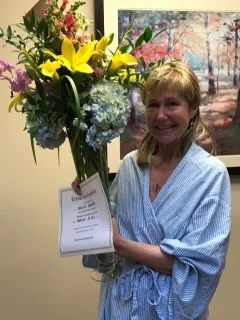
More tomorrow (I hope) on other observations and side effects of treatment and a funny analogy too good to miss! Also more on a clinical trial program that I’m enrolled in. And here’s my radiology poem—Deux Ex Machina means Gods of the Machines. It’s a literary term from ancient Greece when the playwrights would bring in a platform with gods on it to solve a conflict or any loose thread of the play. Also the last line means that those of us who get to be dubious “stars” from photon light, will go on to emit light and love to others. The photo was after my last radiation
Deux Ex Machina
The absolute champions of absorbing light are called black body objects, which is a term applied to anything that absorbs all light. Stars are almost perfect black bodies- they’re one of the closest things to them in nature. Astrophysical April 28, 2015
A giant, white robot eye swings down
and hovers over my war-scarred chest,
decorated with sharpie tattoos,
that line up a photon beam as I lie awake
half-naked and nervous on a table in a cavernous room.
I’m alone, my left breast exposed,
while techs aim the invisible beam
from their safe spaces where they watch me--
the *star* of several cameras—a body absorbing light.
A microphone voice says, ““Hold your breath.”
The machine speaks: Click click click, buzzzzzzzzzzzzz.
and some backstage computer generates graphs
I watch on a video monitor in my room
while my breath-hold protects my heart.
Twenty seconds pass. “Breathe normally.”
Big exhale. Relief. Repeat 3x. I count.
While beams hum and click, I wait
for the giant eye to close, and my mind drifts
to stardust, vulnerable hearts
and how we stars might emit stored light.